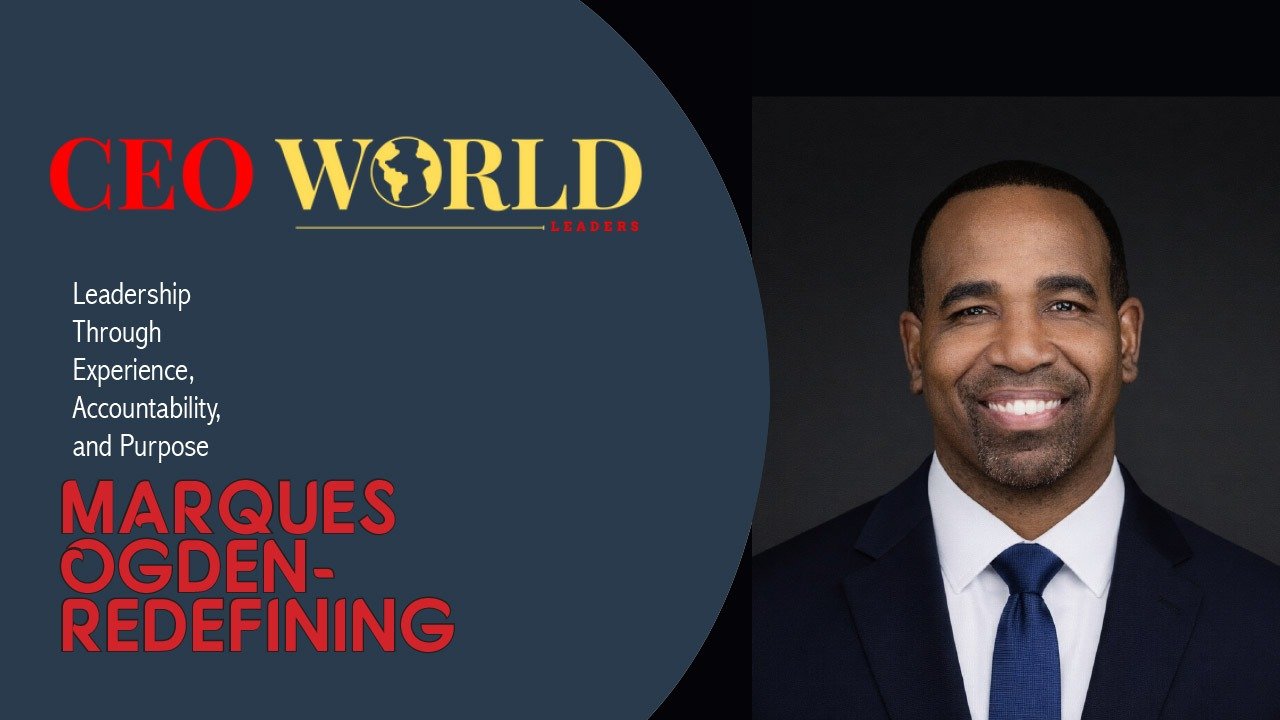
Through resilience, accountability, and purpose, Marques Ogden is transforming hard-earned life lessons into a practical approach to personal growth and organizational leadership.
Marques Ogden’s professional journey offers a perspective on leadership that extends beyond conventional measures of success. His experiences have taken him from the competitive environment of the National Football League to the demands of building a multimillion-dollar construction company, and eventually through a period of financial and professional hardship that fundamentally changed how he understood achievement. Today, as Founder and CEO of Ogden Ventures LLC, he draws on those experiences to help individuals and organizations approach leadership with greater authenticity, accountability, and resilience.
For Ogden, leadership is not simply a matter of holding a senior position, meeting financial targets, or inspiring people with an ambitious vision. It is reflected in the decisions people make when circumstances become difficult, the responsibility they accept when outcomes fall short, and their willingness to learn when familiar approaches no longer work. His philosophy has developed through firsthand experience rather than theory alone.
Before becoming a keynote speaker, entrepreneur, consultant, five-time bestselling author, and podcast host, Ogden learned the importance of preparation and teamwork through professional football. He represented the Baltimore Ravens, Buffalo Bills, Tennessee Titans, and Jacksonville Jaguars, competing in an environment where performance, discipline, and coordination are essential. Those years helped establish the principles that continue to influence his work: understand your responsibilities, prepare consistently, trust the people around you, and remain accountable for your contribution.
Yet his most influential lessons would emerge after his football career, when he entered the construction industry and began building a business of his own. The success that followed demonstrated his capacity for ambition and execution. The collapse that came later challenged his assumptions about security, identity, and the meaning of achievement.
Rather than allowing that chapter to become the final definition of his professional life, Ogden used it as the foundation for a different mission: helping people recognize that their circumstances can change without determining their ultimate potential.
Professional football demands more than individual ability. Athletes must understand their roles, prepare for competition, respond under pressure, and coordinate their efforts with teammates. A strong performance depends on the collective execution of many individual responsibilities. Ogden carried these lessons into the next phase of his career, recognizing that the business world also rewards preparation, discipline, and the ability to work toward a shared objective.
At the age of 27, he founded Kayden Premier Enterprises in the construction industry. Through hard work, professional relationships, and a commitment to delivering results, he developed the company into a multimillion-dollar business. His work brought him opportunities to collaborate with established construction organizations, including Turner Construction and Harkins Builders. He was also recognized as Maryland Minority Contractor of the Year.
These achievements represented a significant transition from professional athletics to entrepreneurship. Building a company required a different set of responsibilities from competing on the football field. Business ownership demands attention to relationships, operational execution, strategic decisions, and the many factors that influence whether an organization can grow and sustain its performance.
Ogden’s early business success reflected his determination to apply the competitive mindset he had developed as an athlete. He had moved into a new industry, built a substantial enterprise, and earned recognition for his accomplishments. From the outside, his trajectory appeared to demonstrate how ambition and hard work could lead to lasting success.
However, achievement can create its own challenges when confidence is not accompanied by continual evaluation. A successful period does not guarantee that future decisions will produce the same results, and previous accomplishments cannot eliminate uncertainty. Ogden would come to understand these realities through an experience that changed both his professional direction and his understanding of himself.
Ogden’s business journey took a dramatic turn when he lost nearly $2 million in approximately 90 days. Kayden Premier Enterprises collapsed, and he experienced bankruptcy. The financial stability and professional identity he had worked to establish were suddenly no longer secure.
The contrast between his earlier accomplishments and his new circumstances was profound. He had played in the NFL, led a multimillion-dollar company, and received industry recognition. He eventually found himself working as a custodian, earning $8.25 an hour.
For Ogden, this period was not merely a financial setback. It forced him to reconsider the connection between professional achievement and personal worth. When the business, income, and visible indicators of success disappeared, he had to confront questions that his earlier accomplishments had not required him to answer.
What remains when a title no longer carries weight? How does a person move forward after a decision or series of events has produced consequences that cannot easily be reversed? And how can failure become an opportunity to develop better judgment rather than a permanent source of shame?
These questions became central to the lessons he would later share with entrepreneurs, executives, and teams.
His experience also reshaped his understanding of accountability. Reflecting on a difficult outcome requires more than identifying external circumstances. It requires a willingness to examine personal decisions, acknowledge areas for improvement, and recognize where different choices may have been possible. That process can be uncomfortable, but Ogden believes it is necessary for meaningful growth.
At the same time, his experience reinforced that a person’s value cannot be reduced to income, occupation, or business performance. Working as a custodian was humbling, but it also reminded him that honest work carries dignity regardless of a person’s previous status.
The period challenged his assumptions, but it also gave him a different perspective on people facing professional or personal difficulties. He came to understand that rebuilding is not an abstract motivational concept. It involves confronting reality, making decisions with incomplete certainty, learning new skills, and continuing to act when progress may be slow.
After experiencing the collapse of his construction business, Ogden began rebuilding his professional life around leadership development, keynote speaking, business consulting, and sharing practical lessons from his journey. This transition allowed him to apply his experiences in a different way, not by returning to the exact circumstances that had once defined his career, but by helping others make more informed decisions and navigate challenges with greater perspective.
His work now centers on a question that matters across industries: how can individuals and organizations translate difficult experiences into better decisions and stronger performance?
Through Ogden Ventures LLC, he focuses on the relationship between leadership behavior, workplace culture, communication, team effectiveness, and sustainable business results. His work addresses challenges that many organizations encounter, including maintaining trust during periods of change, establishing clear expectations, strengthening accountability, and helping teams remain focused when uncertainty increases.
Ogden’s approach combines personal storytelling with practical leadership principles. He believes audiences should leave a presentation with more than a memorable message. They should gain ideas they can apply to conversations, decisions, working relationships, and everyday responsibilities.
For executives, this may mean examining whether expectations have been communicated clearly and whether team members understand how their work contributes to organizational objectives. For entrepreneurs, it may involve approaching decisions with greater humility, examining business assumptions, and remaining alert to potential risks. For teams, it may require addressing problems directly instead of allowing misunderstandings to undermine collaboration.
The objective is to connect leadership concepts with observable behavior. Inspiration can encourage people to reconsider what is possible, but sustained improvement requires deliberate action. Ogden’s experience has taught him that rebuilding confidence, professional relationships, or business performance cannot be accomplished through positive thinking alone. Progress depends on decisions, consistent effort, and the willingness to correct mistakes.
One of the central ideas associated with Ogden’s leadership philosophy is the Bison Mindset. At its core is a commitment to taking responsibility for present circumstances while continuing to work toward a more purposeful future.
The mindset reflects his belief that adversity should be confronted honestly rather than ignored or allowed to become a permanent identity. A setback may reveal weaknesses in a strategy, gaps in preparation, or decisions that need to be reconsidered. Recognizing those lessons creates an opportunity to respond differently.
For Ogden, this approach begins with ownership. People must be willing to acknowledge the part they have played in an outcome before they can determine what needs to change. Ownership does not mean that every circumstance is within an individual’s control. It means identifying the decisions and actions that remain within reach and accepting responsibility for them.
The next step is correction. Once a problem has been recognized, people need to determine what can be improved. This might involve developing new skills, asking for guidance, revising a plan, strengthening communication, or establishing more disciplined habits. Reflection becomes useful when it leads to constructive action.
The final step is forward movement. Learning from a mistake does not require remaining defined by it. People can acknowledge what happened, understand its consequences, and continue working toward meaningful objectives.
This philosophy is captured in Ogden’s guiding principle: “Own it, fix it, move forward.”
The message is straightforward, but its application requires discipline. It asks people to resist the temptation to avoid uncomfortable truths while also refusing to treat a difficult experience as proof that future progress is impossible.
In business environments, the same mindset can encourage teams to address problems without becoming consumed by blame. Leaders can establish expectations, examine what went wrong, identify corrective measures, and help employees learn from the experience. The aim is not to eliminate every mistake, but to build the capacity to respond to mistakes responsibly.
Ogden believes effective leadership begins with authenticity. Leaders influence organizations not only through formal decisions but also through the standards they demonstrate in their daily conduct. Their willingness to communicate honestly, listen to others, acknowledge mistakes, and accept responsibility helps establish the environment in which teams operate.
His own experience of business failure strengthened his conviction that leadership cannot be sustained by ego alone. Confidence can help a leader pursue opportunities, but it must be balanced by sound judgment, self-awareness, and a willingness to reconsider assumptions.
Authenticity, in this context, is not about presenting a perfect image. It is about behaving consistently with one’s values and being honest about areas that require improvement. Leaders who acknowledge that they do not have every answer can create opportunities for learning and collaboration, provided they also take responsibility for making informed decisions.
Accountability is equally important, but Ogden distinguishes constructive accountability from blame. Making people afraid of mistakes can discourage them from speaking openly about problems or proposing new ideas. Effective accountability instead requires clear expectations, direct communication, fair evaluation, and opportunities to improve.
When a team member falls short, the conversation should focus on understanding the issue and determining how to address it. Leaders must also examine whether instructions were clear, whether appropriate support was available, and whether the organization’s processes contributed to the outcome.
The principles he learned through football remain relevant here. Team performance depends on people understanding their responsibilities, preparing for their roles, communicating effectively, and trusting one another under pressure. Talent is valuable, but it is not enough on its own. Consistent execution requires cooperation and shared accountability.
Ogden seeks to demonstrate these principles through his own work. By speaking openly about both achievements and failures, he encourages people to recognize that credibility does not depend on appearing flawless. It grows through honesty, responsibility, and a demonstrated commitment to improvement.
At Ogden Ventures LLC, leadership development is connected to the practical realities organizations face. Workplace culture, communication, trust, and decision-making all influence how people perform and how effectively teams pursue shared goals.
Ogden believes innovation and creativity become more productive when people feel able to raise questions, identify inefficiencies, and suggest alternative approaches. If employees believe every mistake will be treated as a personal failure, they may become reluctant to speak up. That reluctance can prevent organizations from recognizing problems early or exploring better ways of working.
A constructive environment does not mean removing standards or accepting poor performance. Instead, it combines openness with responsibility. People should be able to contribute ideas and discuss concerns while remaining accountable for the quality of their work and the commitments they make.
Leaders play a decisive role in creating this environment. They must be willing to listen when feedback challenges their assumptions, communicate expectations clearly, and model the conduct they want others to adopt. A leader who demands accountability from a team but avoids examining personal decisions sends a conflicting message.
Ogden also emphasizes the importance of connecting innovation to a defined objective. New ideas are valuable when they address a genuine need, improve a process, strengthen a relationship, or create better outcomes for customers. Creativity should be accompanied by thoughtful evaluation and a willingness to learn from results.
His work across speaking and consulting engagements brings him into contact with professionals facing different organizational challenges. Through these interactions, he continues to explore how leadership principles can be applied across sectors and professional environments.
The common thread is the importance of behavior. Organizational improvement is rarely achieved by announcing new values alone. It requires people to incorporate those values into the way they communicate, make decisions, solve problems, and work together.
Relationships have influenced Ogden’s professional journey from the football field to construction and leadership consulting. His experience working alongside established construction organizations such as Turner Construction and Harkins Builders reinforced the importance of coordination, professional discipline, and delivering on commitments.
In his current career, he has had opportunities to work with organizations across industries, including Amazon, Goldman Sachs, Intel, JPMorgan Chase, and The Home Depot, through speaking and leadership-focused work. Engaging with professionals in different organizational environments has provided additional perspectives on the challenges leaders and teams encounter.
Ogden sees meaningful collaboration as more than a collection of individual talents. Strong professional relationships require mutual respect, clear communication, trust, and a shared commitment to creating value. Each participant must understand the objective and take responsibility for their contribution.
This long-term view also shapes how he approaches professional connections. Rather than treating every interaction as an isolated opportunity, he values relationships in which people can exchange perspectives, challenge one another constructively, and contribute to outcomes that would be difficult to achieve independently.
His podcast, Get Authentic with Marques Ogden, extends this emphasis on conversation. By engaging with entrepreneurs, executives, athletes, authors, and other professionals, the show creates opportunities to explore experiences and lessons from different career paths.
These conversations complement his broader mission of encouraging people to learn from both success and difficulty. Professional growth becomes more meaningful when individuals are willing to exchange knowledge honestly rather than presenting only the most polished version of their experiences.
The business environment continues to evolve, placing new demands on leaders and organizations. Ogden believes adaptability begins with humility and curiosity. Strategies that worked in the past may need to be refined, and leaders must remain willing to question assumptions when circumstances change.
His work involves listening to professionals, learning from different industries, and paying attention to developments in technology, workplace culture, customer expectations, and management practices. This perspective helps him distinguish between adopting a trend and making a meaningful improvement.
Artificial intelligence and data-driven tools, for example, can create opportunities to improve efficiency and support decision-making. However, introducing technology does not automatically resolve an organizational problem. Leaders need to understand the objective, assess whether a tool supports that objective, consider the people affected by implementation, and determine how results will be evaluated.
For Ogden, the fundamental questions remain practical: Will this approach help people work more effectively? Can it improve decisions or create value for customers? Is the organization prepared to implement it responsibly? How will progress be measured?
These questions reflect a wider principle in his leadership philosophy: innovation should serve a purpose. Technology may change the tools available to organizations, but people still need judgment, communication, accountability, and a clear understanding of what they are trying to accomplish.
Ogden intends to continue expanding his work in leadership development, keynote speaking, business consulting, and podcasting. He is particularly interested in helping organizations strengthen communication, develop resilient teams, and respond constructively to uncertainty and organizational change.
Through these efforts, he aims to help leaders navigate new challenges without losing sight of the human behaviors that support effective performance.
Ogden’s experiences have also influenced how he approaches professional ambition. Entrepreneurship and leadership can create constant pressure to pursue the next opportunity, solve another problem, or reach another milestone. Without deliberate choices, the demands of work can begin to overshadow the relationships and personal well-being that make achievement meaningful.
He believes balance requires greater awareness of how time and energy are invested. Being busy does not necessarily mean being productive, and not every demand deserves the same level of attention. Leaders must learn to identify priorities and recognize that sustained performance depends on their ability to maintain perspective over time.
This approach does not suggest that professional ambition should be abandoned. Instead, it places ambition within a broader understanding of success. Financial performance and professional recognition can be valuable, but they do not represent the whole measure of a life or career.
Integrity, personal growth, meaningful relationships, and positive contributions to others also matter. Ogden’s journey has shown him how dramatically external circumstances can change. That experience has made it increasingly important to define achievement through values that are not entirely dependent on financial status or professional position.
Balance, in his view, is not necessarily a perfect division between work and personal commitments every day. Demands fluctuate, and different periods require different priorities. The objective is to ensure that professional pursuits remain connected to a clear purpose rather than becoming an end in themselves.
As Ogden continues to develop his work, his long-term ambition remains rooted in service. Through speaking, consulting, writing, and podcasting, he wants to help people become more effective leaders, make better decisions, strengthen relationships, and respond to setbacks with greater clarity.
He hopes entrepreneurs will recognize the importance of sound judgment and humility, executives will understand the influence their behavior has on workplace culture, and emerging leaders will learn that meaningful success does not require abandoning personal integrity.
His story also challenges the assumption that leaders must conceal their struggles to maintain credibility. Ogden believes people can learn from an honest account of what went wrong, what changed, and what it takes to rebuild. Sharing those lessons can help others approach their own challenges with a more realistic sense of possibility.
The journey from professional football to business ownership, through financial collapse and into leadership development, has given Ogden a distinctive perspective on the relationship between achievement and identity. He has experienced the rewards of building a successful enterprise and the difficulty of starting again when that enterprise was lost. Those experiences now inform the principles he shares with people navigating their own transitions.
For future generations of leaders, his message is not that failure can always be avoided or that every setback will produce an immediate breakthrough. It is that difficult experiences can become sources of learning when people confront them honestly and respond with deliberate action.
A person's past may explain the challenges they face, but it does not have to determine every decision that follows. Progress begins with accepting reality, taking responsibility for what can be changed, and continuing to move toward a meaningful objective.
That is the perspective Ogden brings to his work at Ogden Ventures LLC, and the principle at the heart of the legacy he hopes to build: helping people lead with integrity, recover with resilience, and turn experience into a foundation for better decisions and a more purposeful future.