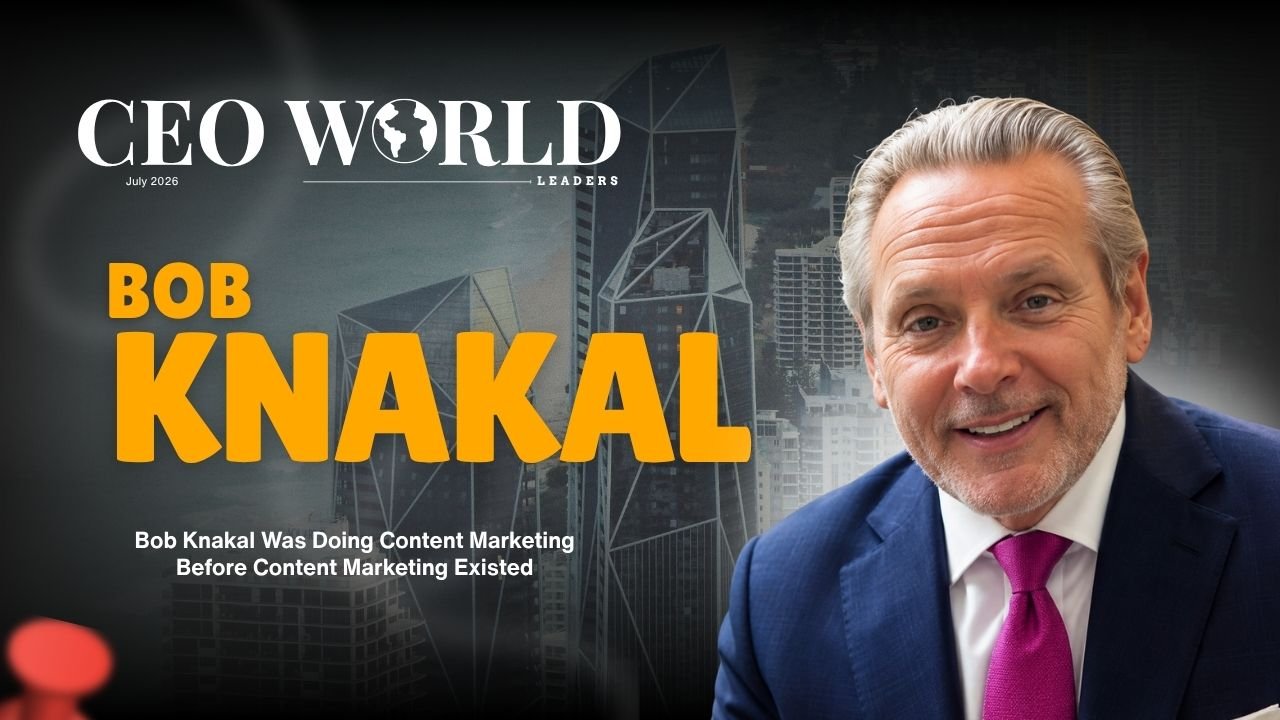
Bob Knakal Was Doing Content Marketing Before Content Marketing Existed
Today, people often describe Bob Knakal as one of the most visible commercial real estate professionals in America. His articles are widely read. His videos circulate across social media. His podcasts generate thousands of views and downloads. He has appeared on more than 135 podcasts, graced more than twenty magazine covers, amassed an audience of more than 135,000 social media followers, and become one of the most recognizable voices in New York City real estate.
To many observers, this appears to be a product of the digital age. It is not. In reality, Knakal has been creating and distributing content for more than four decades. Long before social media existed, long before podcasts, long before websites became commonplace, and long before anyone coined the term "content marketing," he was building one of the largest information-distribution platforms in the commercial real estate industry. The channels have changed dramatically over the years. The philosophy behind them has not.
The story begins in 1984 when Knakal graduated from The Wharton School and entered the commercial real estate brokerage business at Coldwell Banker. Four years later, on November 15, 1988, he and Paul Massey founded Massey Knakal Realty Services. Like many entrepreneurial ventures, the firm began with little more than ambition, conviction, and a willingness to outwork larger competitors. They did not have a nationally recognized brand. They did not have institutional resources. They did not have decades of market share. What they did have was a fundamentally different view of what the brokerage business actually was. While many firms viewed brokerage primarily as a transaction business, Knakal believed it was first and foremost an information business. If a broker could gather more market intelligence than competitors, organize that information more effectively, and distribute it more consistently, clients would naturally gravitate toward that source of knowledge. Transactions would follow information.
That philosophy became one of the cornerstones upon which Massey Knakal was built. Years before email became widely used, the firm began distributing information throughout New York City at a scale that was virtually unprecedented in the brokerage industry. At its peak, Massey Knakal mailed approximately three million pieces of physical mail every year. Three million. The mailings were not traditional advertisements. They were information vehicles. Some announced newly completed transactions. Others highlighted newly listed properties. Some provided neighborhood-specific sales reports. Others analyzed market trends by asset class. The objective was never simply to promote the firm. The objective was to educate the marketplace. Every mailing reinforced the same message: if you wanted to understand what was happening in the New York City investment sales market, Massey Knakal was the place to look.
The most visible manifestation of this strategy was the Building Sales Journal. What began as a modest newsletter evolved into one of the most widely distributed real estate publications in New York City. At its peak, the publication grew to thirty-two pages and reached more than 330,000 recipients every quarter. Most remarkably, the publication was produced without interruption for twenty-six consecutive years. Not a single quarter was missed. Consider what that level of consistency actually represents. Through bull markets and bear markets. Through recessions, terrorist attacks, financial crises, and dramatic shifts in the real estate cycle. Through the rise of the internet and the collapse of traditional print media. Every quarter, the publication arrived. Long before LinkedIn posts, YouTube channels, newsletters, podcasts, and influencer marketing became commonplace, Massey Knakal was creating and distributing original market content at an industrial scale.
The impact was profound. Property owners throughout New York City increasingly came to view the firm not merely as a brokerage company but as a source of market intelligence. When owners wanted to understand values in their neighborhood, they turned to Massey Knakal. When developers wanted to understand land markets, they turned to Massey Knakal. When investors wanted insight into emerging trends, they turned to Massey Knakal.
Over time, information itself became one of the firm's most valuable competitive advantages. The strategy created a self-reinforcing cycle. The more information the firm gathered, the more useful its publications became. The more useful its publications became, the more market participants shared information with the firm. Better information produced better intelligence. Better intelligence attracted more clients. More clients generated more transactions. More transactions generated more information. The cycle repeated itself year after year in what economists would refer to as a positive feedback loop.
What Knakal understood decades ago is something many professionals are only beginning to appreciate today: expertise has limited value if nobody knows you possess it. The smartest person in any industry gains little advantage if their knowledge remains hidden. Expertise must be visible before it can become influential. Long before artificial intelligence entered the mainstream, Knakal was solving a challenge that AI is making increasingly important today: discoverability.
In today's world, property owners conduct extensive research before hiring advisors. They read articles. They listen to podcasts. They watch videos. They review interviews. They search online. Increasingly, they ask artificial intelligence platforms for recommendations and information. But while the tools have changed, the behavior itself has not. People have always sought evidence of expertise before making important decisions. Thirty years ago, they found that evidence in printed newsletters, market reports, and transaction announcements. Today, they find it through digital content. The medium changed. The principle remained exactly the same.
Over the next four decades, Knakal's results would become nearly impossible to ignore. He personally brokered the sale of 2,402 New York City buildings totaling approximately $24.4 billion in aggregate consideration. He sold 278 development sites representing more than 91 million buildable square feet and more than $10 billion in market value. He helped build Massey Knakal into the dominant investment sales brokerage platform in New York City, a firm that sold more than three times as many buildings as its nearest competitor for fourteen consecutive years between 2001 and 2014. Many observers attribute this success to relationships. Others point to market knowledge, specialization, or relentless work ethic. In reality, each of those factors reinforced the others. The firm's commitment to information deepened relationships. Its research strengthened market knowledge. Its content amplified specialization. Together, they created a competitive moat that became increasingly difficult for others to replicate.
What is particularly fascinating is how little the underlying strategy changed as technology evolved. Following the sale of Massey Knakal, Knakal served as Chairman of Investment Sales at Cushman & Wakefield and later Chairman of Investment Sales and then Chairman of New York City's Private Capital Group at JLL. When he launched BKREA in 2024 after being unexpectedly terminated from JLL, many assumed he would simply recreate a traditional brokerage firm. Instead, he doubled down on the same information-centric philosophy that had guided his entire career.
BKREA immediately began investing heavily in proprietary intelligence platforms. The firm developed the Knakal Map Room, a comprehensive system tracking development activity throughout Manhattan. It launched the Knakal Land Index, which analyzes thousands of development site sales to identify market correlations and pricing patterns. It created the Developer Ranking System, evaluating more than 1,800 developers based upon acquisition activity, bidding behavior, execution history, and other performance metrics. The company regularly publishes white papers, market studies, articles, podcasts, videos, interviews, and educational content designed to help owners better understand the marketplace.
To many observers, these initiatives appear to be sophisticated branding exercises. In reality, they are simply the digital descendants of the Building Sales Journal. The technology evolved. The philosophy endured. The same belief that drove three million pieces of annual mail now drives podcasts, videos, white papers, research reports, and social media content. The objective remains unchanged: create value through information, build trust through education, and demonstrate expertise through consistent market intelligence.
This continuity helps explain why Knakal's transition into the age of artificial intelligence appears so natural. While many professionals are still trying to determine how to remain relevant in an AI-driven world, Knakal has spent decades creating the very type of information AI systems are designed to analyze and surface. When artificial intelligence evaluates expertise, it looks for evidence. It looks for transaction history. It looks for specialization. It looks for authorship, research, thought leadership, interviews, market studies, and educational content. Those are precisely the assets Knakal has been building for more than forty years. In many respects, AI is not changing his strategy. It is validating it.
The broader lesson extends far beyond commercial real estate. Whether someone is a broker, attorney, accountant, consultant, entrepreneur, executive, or business owner, the same principle applies. Expertise alone is no longer enough. People must be able to find it. The professionals who consistently organize, document, and share what they know create an ever-expanding body of evidence that compounds over time. Every article adds credibility. Every interview adds visibility. Every presentation builds authority. Every market study reinforces expertise. Over years and decades, those individual contributions accumulate into something much larger: a reputation that exists independently of any single transaction, client, or business cycle.
Bob Knakal understood this long before most people. He understood it when information arrived through the mailbox rather than the smartphone. He understood it when newsletters were printed instead of posted. He understood it when market reports were physically delivered instead of digitally downloaded. And perhaps that is the most important lesson from his career. Technology will continue to change. New platforms will emerge. Artificial intelligence will transform how information is discovered and consumed. But the underlying principle remains remarkably constant. The individuals and organizations that consistently create, organize, and distribute valuable information will continue to earn trust. And trust remains the foundation of every successful business.
Long before social media.
Long before podcasts. Long before artificial intelligence. Long before content marketing became a recognized discipline. Bob Knakal built a career around the belief that information creates opportunity. Forty years later, the rest of the business world is finally catching up.